Fiber powered is a lie: how ISPs sell you coax and call it glass
There's a box on my basement wall where light turns into internet, and most people paying for "fiber" don't have anything close to it. I break down the term "fiber powered," why Spectrum is selling coax as if it's the real thing, and how the FTTH, FTTN, FTTC alphabet soup exists to hide exactly where your fiber connection actually stops.
I also get into the AT&T versus Spectrum lawsuit, because AT&T is suing Charter over the fiber powered branding and they're not wrong. But AT&T pulled the same trick with fake 5G labels on 4G phones a few years back, so nobody in this fight is innocent. I explain what HFC networks are, why your upload speed gets choked on shared coax, and what the fine print is actually admitting when you read it closely.
This is a consumer rights problem dressed up as a tech story. If you're paying for internet every month, you deserve to know what wire is actually running to your house.
The word fiber ends up printed on bills for wires that are copper that have no light whatsoever to go through. Little pulses of electricity. And there's a whole vocabulary built to keep people from noticing it. A lot of buzzwords. A lot of marketing tricks and tactics. Well, I'm going to pull the veil on all of that marketing jargon today. We're going to talk about this because there's a term that's being used in the industry called quote unquote fiber powered. Well, we're going to talk about that. We're going to talk about Spectrum's HFC network, the whole FTTX naming game and yes, I will
tell you what these acronyms mean in a little bit. We're also going to talk about AT&T versus Spectrum, yeah those two are in a fight right now. And the one consumer protection that showed up worked and is already getting trimmed back. Now, there's a little box on the wall in my basement where the light comes in and no, that's not a metaphor. Real pulses of light, a hair-thin strand of glass runs from the pole in my backyard underground to my basement and into a little box called an ONT. I know it's a lot of acronyms. That one I'll tell you right now. That stands for optical network transport.
I have real fiber. The whole thing. One gigabit symmetrical. One gig up, one gig down. And no, I don't need two gigs, I don't need two and a half gigs, I don't need five and only ten. All these tech YouTubers that like to gloat about how faster internet is. Some of them, I've seen this a couple times on YouTube, some of them like to boast about having ten gigabit per second coming into their house. Nobody needs that. Sorry, it's a side tangent, sorry, I just had to get that off my chest. Now, back to fiber running into my house, at least a one gigabit per second that's
running to my basement, to my unified system and going through the house. I know how lucky that is. I know how lucky I am to have fiber here to the home because most people don't have that and a lot of them are thinking that they do because they've been duped by the internet service providers. This is the whole reason I've been annoyed this week because that AT&T versus Spectrum fight that we're going to talk about, AT&T is calling out Spectrum's shenanigans. But, but, AT&T is not exactly in the clear on this because they've done the same BS with 5G on their 4G network.
I got a lot to talk about, I'm worked up this week. I'm Tyler, thanks for being here. This is the Tyler Woodward Project at TylerWoodward.me. This is the show where I show up, worked up on things. That most people probably don't care about, but I do because I'm just that kind of person. Some people like trains, I like tech. You know, and the other thing is too, a lot of things used to be a lot simpler than they are now. And today's word is fiber. And how he keeps ending up printed on bills for wires that are not copper, they do not contain any light.
They're pulses of electricity. Everything I'm about to say here is my opinion. My read on it, fair warning. Yes, as if you couldn't tell already by the first four minutes, I'm running a little warm on this one. Here's my honest, the mission up front. I have no skin in this fight. I already have the good version. Nobody's fooling me here. I'm smart enough to know what the difference is between fiber and copper, but I know some of, some of you out there listening might not, and I want to help you get the good stuff, the good internet, the real stuff, because if you can get fiber, get
fiber. I can look at the box that's on the basement wall. In the upload speed next to it on my speed test and tell you exactly what I'm getting 940 megabits per second up 940 megabits per second down because you got to account for a little bit of overhead when you're going back from the fiber to the copper network. Sorry, just got to point that out there. So this whole episode is me being a little upset on behalf of people that have been sold this fiber powered promise and are not actually really getting fiber to the home.
Close, close, but not quite. You know, so again, this is just me being mad on behalf of other people, which is either fine, which is either a fine way to spend an afternoon or is going to be deeply insufferable. And I can't really tell you really which days or which at this point, but I keep watching people get sold the same word that I got in the mail the other day from a certain internet service provider for a wire that will never do what my wire is doing here at the home.
I can't let that sit because I hate this marketing crap. They're trying to sell you something it is not. So let me tell you what fiber powered really means, because it sounds like it should mean fiber. And again, as we've already established, it doesn't. Real fiber is a strand of glass carrying your data as light all the way to your house. And the best part about fiber is it's symmetrical upload is as fast as that download almost no lag low latency if you're if you're a gamer, it's what you want.
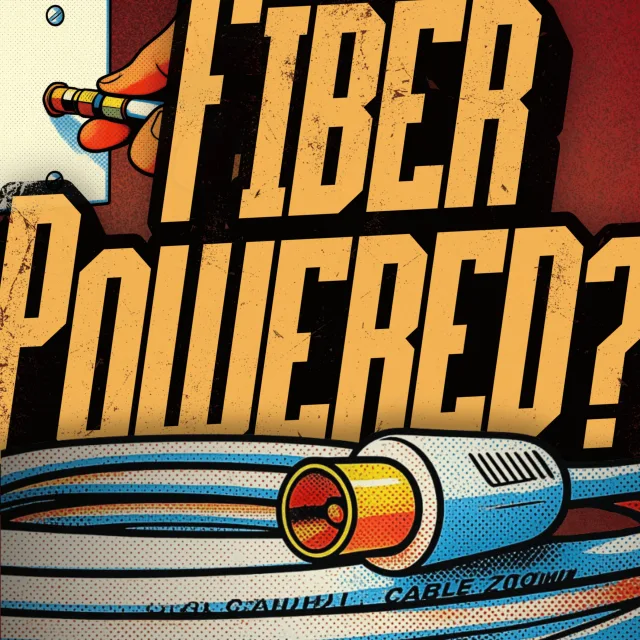
It doesn't care about the weather or your neighbors. That's what's in the box on my basement wall fiber powered means the glass runs to a box down the street and from that box to your house. It's copper coax the cable TV wire. Pitcher it that wire that you screw screw into the back of your TV, I guess whoever still has cable TV, that's what it is. The same one that ran cartoons into your living room. In 1998, the word doing all lifting there is powered.
Your internet is powered by fiber the way a gas station sandwich is powered by a kitchen microwave somewhere. Technically, yes, a kitchen was involved, not the same as it being fresh. And here's the trick. It isn't aimed at the part of you that knows what coax is. It's aimed at the tired part that just wants the internet to work no shame in it, but that's the target that last stretch of copper is where you lose the thing you thought that you bought that you're paying monthly for, you know, $70, $80, $90 a month, your upload is getting choked down
to a fraction of your download. You share that copper with the whole block. Your neighbor, both sides, the neighbor behind you, neighbors cross street, you're sharing it with all of them. So when everybody gets home in the evening after work, after school, and turns on the TV, the computer, the laptop, you feel it. That isn't fiber. That's cable wearing. Well, since it's almost Halloween, a fiber costume. The company doing this, the loudest is Spectrum. And yes, Spectrum has grown quite a bit over the last few years.
They bought a bright, what was a bright house in Florida? They bought a Time Warner, and I'm sure they've gobbled up other little smaller ISP and cable companies all over the country. The other name they go by or used to go by, the parent name, is still Charter Communications. You know, if you wanted the parent corporate name. They ran a whole campaign calling the service Fiber Power delivered over the Spectrum Fiber Broadband Network. Sounds fancy, right? Sounds like, oh man, I'm getting fiber, like those other people that have Google fiber and whatever. I don't know what else is out there.
What is it now? What did what did Centralint call it? Quantum fiber. In the fine print. And it is very fine print. They even admit it. Powered by fiber connected to your home by coaxial cable. They wrote down the truth. They just wrote it really fricking small. So here's my message to Spectrum. And I mean the people upstairs, those marketing executives, not the tech that's trying to install your service. They're just trying to do their job. You already own the Fiber Spectrum.
It runs to the node at the end of the block. You're one bill away from the real thing. Finish it. Pull the glass, the last stretch to the house. And you have money for it. It's sitting in the pay package of whoever signed off on the word powered or the term fiber powered. Take a slice of what you hand the executive suite and put it in the ground. In the real wire all the way to the home. You keep printing the word fiber in front of.
All right, I'll get off my soapbox on that one. And remember like 12 minutes ago, I said I would explain what all these acronyms mean. So let's do that in the alphabet. Well, it's, it's, it's a bit. FTTH, FTTN, FTTC. What does all that mean? Well, FTTH is fiber to the home. FTTN is fiber to the node. And well, FTTC, if you haven't guessed yet, is fiber to the curb. They call the family FTTX, fiber to the X.
And the X is the con. It's wherever the fiber quits. Fiber to the node means the glass reaches the box on your street. Usually down on a pole somewhere or in a cabinet on a corner. And it stops there. The only letter. My dog's over here saying hi. Hey Pixie. I gotta give her some pets. She's, she's very needy. All right. Where was I? Oh yeah. So that FTTX, that's where the fiber ends. That's where the glass is reaching some cabinet or a pole on your street.
The only letter that means what you were sold if you were getting fiber to the home, FTTH. Well, I just gave it away. H. Home. All the way to the door. Fiber powered. That stupid term is just fiber to the node down the street. And then it rides on coax the rest of the way to your house. Now, I'm not saying okay, you know, a few hundred feet. That's where the fiber ends and you're getting it coaxed because eventually it does go to Ethernet. It does turn back to coax somewhere usually in your house. The problem though. And we might get further into this is HFC.
What is it? I'm blinking on what HFC means. But basically when you're on copper, you don't get the symmetrical speeds. You know how lopsided is asymmetrical. You usually get what 100 megs down and 10 megs up. That's where the limitation of this technology comes in. Now, spectrum in some areas is doing high frequency split or whatever it is, where you can do symmetrical on coax, but that's not widespread yet. So, because I know someone's going to type in the comments and call that out. So I'll get that out of the way now. All right. Now, here's the other part. This is where it starts to get good.
And I mean infuriating. Remember how we talked about AT&T at the beginning of this episode? Yeah. AT&T, the same AT&T that a few years ago decided to do some shenanigans. Yeah, we're talking about that one. The company that got mad enough to drag spectrum into court over this big blue. Last month, in August, AT&T has sued Charter and federal court over in Texas arguing that fiber-powered tricks people into thinking they're buying real fiber. Which we've established. You're not.
You're getting it on coax. And on the facts, AT&T, they're right. I hate admitting it, but, you know, big blue is right. But you have to know, again, who's making the argument. Again, AT&T. AT&T, the same company that I mentioned a few years back, did some of their own shenanigans. AT&T, took an ordinary 4G phone network and pushed a little software update that made your phone say 5G-E. You know, in the corner? 5G-E.
You want to know what the E was? Well, the E stood for evolution. It wasn't 5G. It was 4G with a little fancy new sticker on it. Well, remember Sprint? Remember those guys? They sued. A review board told them to knock it off. And eventually they did. So the company, standing up in court right now saying you shouldn't have to be an expert to know what you're buying is the same company that put a fake 5G label on millions of phones. It's rich, isn't it? That's how these corporate telecom companies work. They're both right about each other.
That's the joke, if you haven't figured it out. Everybody in this fight has done the exact thing they're accusing the other guys of doing. Nobody here is the good guy. They're all taking turns being the one who got caught. And it isn't only the word fiber. The whole vocabulary is built like this. Up to. Watch for up to. When they say speeds up to a thousand. Up to. That's the whole sentence. You can get a fraction of that every day. And they've told you the truth.
It's a ceiling. That they have no plans of helping you reach. Sold to you as a promise. You signed up for it. 500 megabits per second? Yeah, but read that little word up in the corner that says up to 500 megabits per second. Most people don't achieve those speeds. For a various number of reasons, it could be the network outside the home. I'm talking about the cable company, the phone company, whoever. It could be their own home equipment. It could be their own local network. So many different factors, but yes, it could be that. But a lot of times, remember that fiber is going to a node on the corner of your block and getting split with everybody in your neighborhood.
So up to, well, if everybody is using the 500 megabits per second that they're sold, well, something's got to give somewhere if there's only a gig pipe coming into that node. A lot of times it's 10 gigs, but you get to just what I'm saying. Now, give me one fact, and then I'll be done with the chart stuff. Charter, the company running the loudest fiber ads, and I put fiber in quotes,
told the government that it's real 100% fiber. The glass to your house version reaches only a small number of customers. Everybody else gets the fiber ads that rides on copper. So the fiber and fiber powered is real. It's just probably not going to your house. Then there's the price. The number they quote you is usually a promo. Charter does this, Comcast does this, AT&T does this, Verizon does this.
They usually give you some awesome ass promotion to get you in the door, sign the piece of paper, and it's real, it's a real price, usually for a year or two, and then it climbs. And then it climbs more, and then next year they raise the price again, maybe twice a year. And the climb, well that was their whole plan, because these guys are cons. The cheap number was debate, and a lot of them cap your data and watch what you do on the pipe you rent from them anyways, because you're the product and the wire is debate. All right, I gotta take a breath here. That was a grim run.
You stuck it out so far. Hey, power to you. Let me talk about the part where I need to stop joking, because this is the one that got me. For a minute there, we had a fix. We had a real fix. A few years ago, the government made these companies put a label on their service, a broadband label. If you haven't seen it, they modeled it on the nutrition fix, the little rectangle that you see on the side of a cereal box. I loved it.
Standardize, same format no matter who the internet service provider was. Here's the real price after the promo. Here's the real typical speed that you will see, none of that up to fantasy nonsense. Here's the data cap, the fees, all of it. In one box, a nutrition label looking box for broadband facts that you could hold up next to another company and actually compare the real details. It was the one thing that cut through all of this nonsense. You didn't have to know what HFC meant, which I'm blanking on.
You didn't have to decode what Howard Bye meant. The label was going to tell you. They kicked in for everybody back in 2024. And, well, I gesture to everything what's happening right now around the country, in this country, by late 2025, the FCC voted to start pulling pieces of it back. Because, of course, they did. Now, I want to be fair because they're not deleting the whole label.
They still get an A for effort or whatever. They're stripping out requirements because I'm sure they've been lobbied to. So companies, they don't have to read the label to you over the phone. Don't have to offer it in another language. Don't have to keep it in a format on a computer or, I'm sorry, that a computer could read. They don't have to show it to you inside your own account. Just little cuts, six of them so far.
And I swear, I am not making this part up. The official filing where they propose weakening the transparency label is titled in part, delete, delete, delete. That's the name on the file. On the transparency rule. Delete, delete, delete. Delete, delete, delete. One of the FCC commissioners called it one of the most anti-consumer things she had seen in her time there.
The chairman called it simply cutting red tape. The usual words in today's political climate, ah, nothing to worry about, right? So the one tool that let you see through all of it, showed up, worked for a year, and is already getting quietly chopped up, trimmed back, whatever. Not killed, just a little trim at a time until it's a shell of what it was supposed to be. Just enough that the average person can't use it and nobody has to own killing it outright. I mean, we're onto this con, aren't we?
You're allowed to be angry about that. Consider this your permission slip. Not at the wire. At the choice to make the wire harder to see clearly. That was a horrible analogy. You want to know what really gets me. If you haven't figured it out yet. We used to have a connection that was bad, flat out bad, horrible, excruciating, and it never once lied to you about it. Do you know what I'm talking about? You can hear those screeching sounds in your nightmares some nights.
Dial up. America online. Yeah, AOL had its own problems, but at least think of dial up in the general sense of dial up. MSN, NetZero, whatever you had. That screech. That static. The two robots screaming at each other to shake some hands. It kicked you off the second somebody picked up the damn telephone. And it told you exactly what it was every time. You heard it working. You heard its limits. Now. We're officially out of the dial up era now because AOL finally killed it off for good last year in 2025.
And there were still a couple hundred thousand people on it. And you know why there was a couple hundred thousand people still on AOL in 2026? Because nothing better ever reached them. We traded a bad connection that was honest for a good one that isn't. The tech got so much better, so much better. And the words, typical corporate telecom, well they got a whole lot worse.
You know why they got worse? Because there's no competition. You know, in the dial up days, the phone company delivered the phone line to your home. They sold you the phone line, but anybody with a few phone numbers and some modems, they could spin up an internet service provider. I mean, you had dozens. So many dial up internet service providers. I'm trying to think, you know, you had, oh, some of the bigger names.
You had Earthlink. You had MSN. Did Yahoo do dial up? Yahoo probably did dial up. You had AOL. You had Juno. Oh, I say Earthlink, Juno, that zero, AOL, MSN, Yahoo. I'm sure there was others. You had competition. When the people handling the wires got involved in doing the internet. Well, it got better. It got faster because they owned the network. They could improve, make actual infrastructure improvements.
And in most towns, you still only have the cable company and the phone company. You do get a little bit of, you know, you can get out there now with some fixed wireless access like, you know, 5G from Verizon and T-Mobile and AT&T. So where you only have a cable and a phone company, you could probably jump to a cellular provider. There is Starlink now. But even Starlink and fixed wireless access, FWA through the cell companies, they still only have limited reaches. There's still dead spots out there.
So the dial up providers, they didn't own the hardware. They didn't own the infrastructure. They couldn't keep up with the big boys who actually owned the infrastructure that they had previously delivered services on. And I wonder, and I'm sure they've tried this, maybe we should open up the wires, let more providers on it. Utopia Fiber is a company out there that does this. Oh, where are they at? Utopia, let's see, Utopia Fiber. They are... What the hell are they? Utah. They're over in Utah.
And what they do, I'm going to bring up their website here, is they build out the infrastructure all the way up to 10 gigabits per second. These guys are amazing. And then you can be a provider and be on that network, sell your services. Utopia lays the fiber, but then allows other providers to lease that line and deliver services to you. I mean, you've got so many companies out there who are on this service. Just in Utah, you have Three Wave, you have Beehive, you have Centracom, you have ETS, Fastel, FiberNet, Fusion, Info West,
Rise Broadband, Sumo Fiber. And you know what these prices are that are listed on their website? For most families, you probably don't need more than 250 megabits per second. And even if you did want a gig like me, I pay damn near $75 a month for my one gigabit per second through Brightspeed. And don't get me started on Brightspeed. That's a whole nother episode. But for most of these providers on here, it's like 40 bucks a month. Because there's competition. Wi-Fi Pros is another one on here. They sell services all the way up to 2.5 gigabits per second at $68 a month.
I pay 75 for Brightspeed and get one gigabit per second. And they still think I'm on DSL. Like I said, that's a whole nother episode. I get sales, door-to-door salespeople coming up trying to get me to switch off of their DSL and go to Fiber. And I have to explain to them, I can show you the ONT on the back of my house where that light goes to, but... Again, a whole nother episode. Let me wrap this up, because this has gone on too long already. Here's where I come down. And it isn't a fix, because I don't know what the fix is for this. Because there's probably, there's just, there's not an easy way to do anything anymore. You already know the game. This game. That they're playing.
So be the person who asked the boring question for somebody who doesn't. When a friend is about to sign up and the ad says Fiber, be the tech hero. I know a lot of us tech guys, we don't like to be the family tech guy. You know, grandma got a new phone, we cringe. But be the friend. When the ad says Fiber, ask, ask the question for them. Does the glass reach the house? Or does it stop at a box down the street? Ask what the real price is after the promo. Now a lot of us have called on to that game. Tech or non-tech. We know corporate America will get you in the door at that low, low rate,
and then bounce it up in about a year. We know how the cable companies operate in this country. That one we've called on to. But ask what it is anyways after the promo. Not the bait price to get you in. Pull up that broadband label with them. While it's, I guess, still allowed to exist. Because that box was built to answer all of this. And there are people working right now to hollow out those rules. Nobody gets fooled here because they're slow. They get fooled because a lot of money gets spent making sure they would. I've got the glass all the way into that little box on the basement wall.
And it's the only thing that kind of buys me a clear view of the whole con. Most people are getting the word without the real technology. Without the proper wire. That was never an accident. Somebody chose it. And they're counting on nobody giving reason to think about it. Be the one who looks. Be the one who speaks up about it. Call them out on this. Marketing nonsense. That's the show. If you want to keep up on it, subscribe wherever you're listening.
And you can find everything else at my website. TylerWoodward.me. Past episodes. And you like to say thanks, buy me a coffee. There is a buy me a coffee link on there. And if you want to leave a voicemail. If anything in this episode struck a chord. Or made you stop and think. Or maybe you got more questions. You can leave me a voicemail. At 608-668-4702. Again, 608-668-4702. Or you can email studio. At TylerWoodward.me. And if you're still listening at this point. On Apple Podcast, Spotify, YouTube Music, Amazon Music. And Auro. Tune in wherever you're listening at.
Give me a rating. Five star rating. If that's all you do today. That'll be alright with me. Thanks for listening. I'll catch you guys next week.